Identity verification is becoming an important part of many Web3 ecosystems. As blockchain applications expand beyond individual cryptocurrency users to include businesses and institutions, projects need ways to establish who is participating.
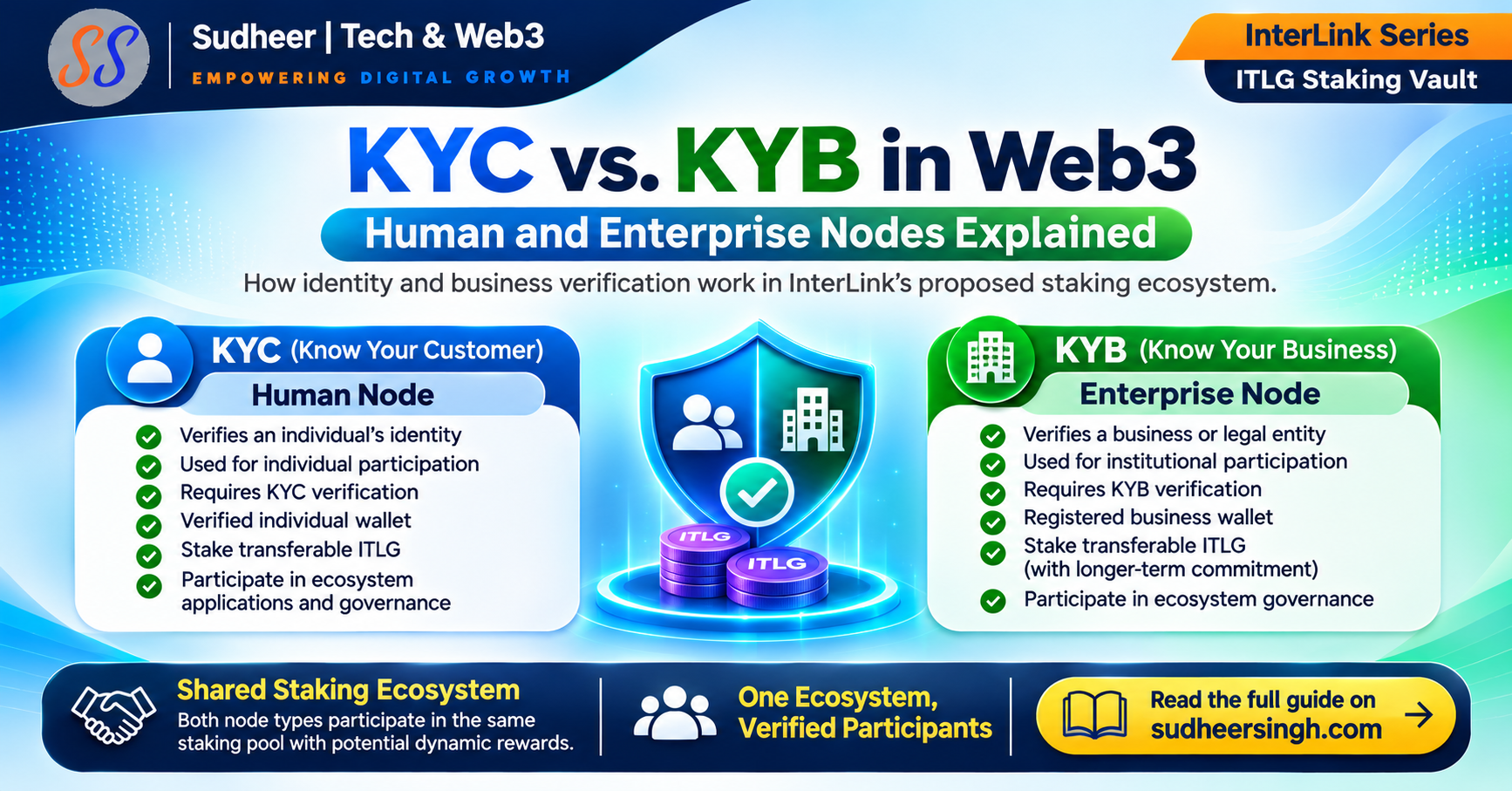
Two common verification approaches are Know Your Customer (KYC) and Know Your Business (KYB).
Although both support identity verification and accountability, they serve different purposes. KYC generally focuses on individuals, while KYB focuses on organizations and their legal identities.
InterLink’s proposed ITLG Staking Vault provides an example of how these approaches could work together. Its proposed Human Nodes would use KYC, while Enterprise Nodes would undergo KYB.
Understanding the difference helps explain why blockchain ecosystems may need more than wallet addresses to support meaningful participation.
What Is KYC in Web3?
Know Your Customer, commonly called KYC, is a process used to verify an individual’s identity.
Traditional financial institutions use KYC as part of customer identification, regulatory compliance, and financial crime prevention programs. Certain cryptocurrency exchanges, digital asset platforms, and blockchain applications also use identity verification.
Depending on the service, KYC may involve:
- Collecting identifying information such as a legal name and date of birth.
- Reviewing a government-issued identity document.
- Checking whether submitted information matches the applicant.
- Performing identity, sanctions, or other compliance screening where required.
- Conducting additional verification when necessary.
Not every Web3 application requires KYC, and verification requirements vary by jurisdiction, service, and applicable regulations.
Why might a Web3 project require KYC?
Blockchain wallets can be created without necessarily revealing the real-world identity of their owners.
This supports permissionless participation, but it also creates challenges for applications that depend on unique, accountable participants.
For example, a governance system designed around individual participation may need safeguards against one person operating multiple accounts.
KYC can help establish a verified relationship between an individual and an account. However, identity verification alone does not automatically guarantee that every participant is unique, trustworthy, or compliant.
Those outcomes depend on the verification process and additional controls.
What Is KYB in Web3?
Know Your Business, or KYB, is a verification process focused on companies and other legal entities.
Rather than establishing only an individual’s identity, KYB examines whether an organization exists, who controls it, and whether the individuals acting on its behalf are authorized.
Depending on the requirements, KYB may involve:
- Verifying the company’s legal name and registration details.
- Reviewing incorporation or business registration documents.
- Identifying directors, controllers, or beneficial owners.
- Confirming the authority of individuals representing the organization.
- Conducting appropriate business and compliance checks.
- Reviewing business information when circumstances change.
KYB requirements can be more complex than individual KYC because organizations may have multiple owners, representatives, and legal structures.
Why does KYB matter for blockchain businesses?
A wallet address alone does not establish which company controls it.
For blockchain applications involving business participation, institutional staking, tokenized assets, or commercial integrations, verifying the organization behind a wallet may provide additional accountability.
KYB can help connect an organization’s legal identity with its participation in a digital ecosystem.
However, business verification does not guarantee financial stability, ethical conduct, or the security of a company’s wallet.
KYC vs. KYB: Key Differences
Although both verification approaches aim to establish reliable identity information, their subjects and processes differ.
| Feature | KYC | KYB |
|---|---|---|
| Full form | Know Your Customer | Know Your Business |
| Primary subject | Individual | Company or legal entity |
| Main objective | Verify personal identity | Verify organizational identity and control |
| Typical documents | Personal identification | Registration and corporate records |
| Additional checks | Identity and compliance screening | Ownership, control, authority, and compliance checks |
| Web3 application | Individual user participation | Institutional or business participation |
| Common complexity | Depends on the individual and risk | May involve multiple people and entities |
The distinction is particularly relevant when a blockchain ecosystem includes both individuals and businesses.
How InterLink Proposes to Use KYC and KYB
InterLink’s announced ITLG Staking Vault model introduces two categories of verified participants: Human Nodes and Enterprise Nodes.
The proposed system would allow both categories to stake transferable ITLG within a shared staking ecosystem.
However, the identity requirements and participation models would differ.
For a broader explanation of the Vault, read our guide to the proposed ITLG Staking Vault, Human Nodes, and Enterprise Nodes.
Human Nodes: Individual Identity Verification
Under the proposal, Human Nodes are intended for individuals who successfully complete the required ITLG KYC process.
Eligible individuals would use verified wallets to stake transferable ITLG and participate in ecosystem activities.
Potential activities include interacting with decentralized applications, using ecosystem services, and participating in governance.
The purpose of verification is to establish a verified individual behind the participating node.
However, the announcement does not fully specify every identity-verification method, privacy safeguard, or account uniqueness mechanism that will apply to the final Vault.
These details should be confirmed through official implementation documentation.
Enterprise Nodes: Business Identity Verification
Enterprise Nodes are intended for companies and institutions that complete KYB verification.
Under the proposal, participating organizations would register business wallets under their verified legal identities.
They would also lock staked ITLG to demonstrate longer-term commitment to the ecosystem.
This approach could make institutional participation more transparent by associating registered businesses with their blockchain activity.
Nevertheless, verification and token locking cannot eliminate market manipulation, financial risk, or operational misconduct.
The effectiveness of the system will depend on its final technical and governance controls.
What Would Human Nodes and Enterprise Nodes Share?
Despite their different verification requirements, both node categories are proposed to participate within the same staking ecosystem.
According to the Daily Task 85 announcement, their shared characteristics include:
- Staking transferable ITLG.
- Participation in a common staking pool.
- Potential access to dynamic staking rewards.
- Participation in the wider InterLink ecosystem.
- A proposed role in ecosystem governance.
The announcement also states that Enterprise Nodes would not receive a separate institutional reward rate merely because they are businesses.
However, this should not be interpreted as a guarantee that every participant will receive the same rewards.
Final eligibility conditions and reward calculations remain important implementation details.
How Identity Verification Connects to Blockchain Governance
Many blockchain governance systems use token-based voting, where voting influence may depend on the number of tokens a participant holds.
Other governance approaches attempt to give participants more equal voting representation.
InterLink’s proposed Vault describes a one-node, one-vote governance vision.
Under such a model, verifying the identity behind each node becomes important because the system must determine which participants are eligible to vote.
KYC and KYB could contribute to that process by establishing whether a node represents an individual or a registered business.
However, identity verification alone does not establish the fairness of a voting system.
The final governance rules must address eligibility, duplicate participation, organizational control, voting security, and other operational considerations.
Until those mechanisms are finalized, one-node, one-vote should be understood as the stated governance proposal rather than a verified operational feature.
Does Identity Verification Make Web3 More Secure?
Identity verification can support accountability, but it is only one part of blockchain security.
A verified participant can still experience wallet theft, phishing, compromised credentials, or financial loss.
Similarly, a verified business may still face operational or cybersecurity failures.
A secure Web3 ecosystem also requires appropriate wallet protections, smart contract security, access controls, transaction safeguards, and transparent governance.
The Privacy Challenge
Identity verification introduces an important question: how should personal and business information be protected?
A blockchain application may need to establish that a participant is eligible without unnecessarily exposing sensitive identity documents or personal information.
Privacy-conscious verification systems should consider:
- Collecting only necessary information.
- Protecting stored verification records.
- Restricting access to sensitive data.
- Defining clear retention and deletion policies.
- Using appropriate security controls.
- Explaining how verification information is processed and shared.
A project’s use of blockchain technology does not automatically make its identity verification process private or secure.
Participants should review the actual privacy and security documentation before submitting sensitive information.
Could Verified Nodes Encourage Long-Term Participation?
InterLink’s proposed Vault connects verified participation with staking and ecosystem activity.
For Human Nodes, the announcement outlines inactivity mechanisms that could affect reward eligibility and continued staking.
For Enterprise Nodes, the proposal emphasizes locked stakes and organizational accountability.
These mechanisms are intended to encourage sustained engagement.
However, the announcement also acknowledges that certain activity-verification procedures and staking parameters remain under development.
Long-term participation ultimately depends on whether the ecosystem provides useful applications, transparent rules, reliable infrastructure, and meaningful incentives.
Verification requirements alone cannot create those outcomes.
What Should Users and Businesses Verify Before Participating?
Before joining any identity-based blockchain staking system, participants should understand both the verification requirements and the financial risks.
Individuals should examine the project’s KYC process, privacy practices, wallet requirements, eligibility conditions, and staking restrictions.
Businesses should additionally review KYB requirements, authorized representatives, organizational wallet controls, and any applicable legal obligations.
Both should examine final staking documentation, reward calculations, governance rules, smart contract risks, and withdrawal conditions.
Most importantly, proposed rewards should never be treated as guaranteed income.
Frequently Asked Questions
Is KYC the same as KYB?
No. KYC generally verifies an individual’s identity, while KYB verifies a business or legal entity, including relevant ownership or control information.
Does every blockchain wallet require KYC?
No. Many blockchain wallets can be created without identity verification. KYC requirements depend on the application, service provider, jurisdiction, and relevant rules.
What is a Human Node in InterLink?
Under the proposed ITLG Staking Vault model, a Human Node is an eligible individual who completes the required identity verification and participates through a verified wallet.
What is an Enterprise Node?
An Enterprise Node is a proposed participation category for verified businesses and institutions that complete KYB and register business wallets.
Do Human Nodes and Enterprise Nodes earn different staking rates?
The announcement describes a shared staking pool without a separate institutional reward rate. However, final reward calculations and eligibility conditions must still be confirmed.
Does completing KYC or KYB guarantee staking rewards?
No. Identity verification does not guarantee reward eligibility, a particular return, or protection against financial losses.
Is InterLink’s proposed governance model already operational?
The Daily Task 85 announcement describes a one-node, one-vote governance vision. Its final implementation and operational status require confirmation through official documentation.
Final Thoughts
KYC and KYB address different identity-verification needs in Web3.
KYC focuses on individuals. KYB focuses on businesses and the people authorized to represent them.
InterLink’s proposed Human Node and Enterprise Node model illustrates how these two approaches could support participation in a shared blockchain ecosystem.
The larger opportunity is not simply to verify identities. It is to combine appropriate verification with privacy protections, transparent participation rules, useful applications, and accountable governance.
As the ITLG Staking Vault proposal develops, its final technical documentation will be essential for understanding how these ideas work in practice.
Continue reading: What Is the ITLG Staking Vault? Human Nodes vs. Enterprise Nodes
Written by Sudheer Singh Banoth, InterLink Tier 3 Ambassador. This independent educational article discusses proposed InterLink functionality. It does not constitute financial, investment, or legal advice.
#InterLink #ITLG #ITL