What if participating in a blockchain ecosystem involved more than holding tokens, checking into an application, or trading digital assets?
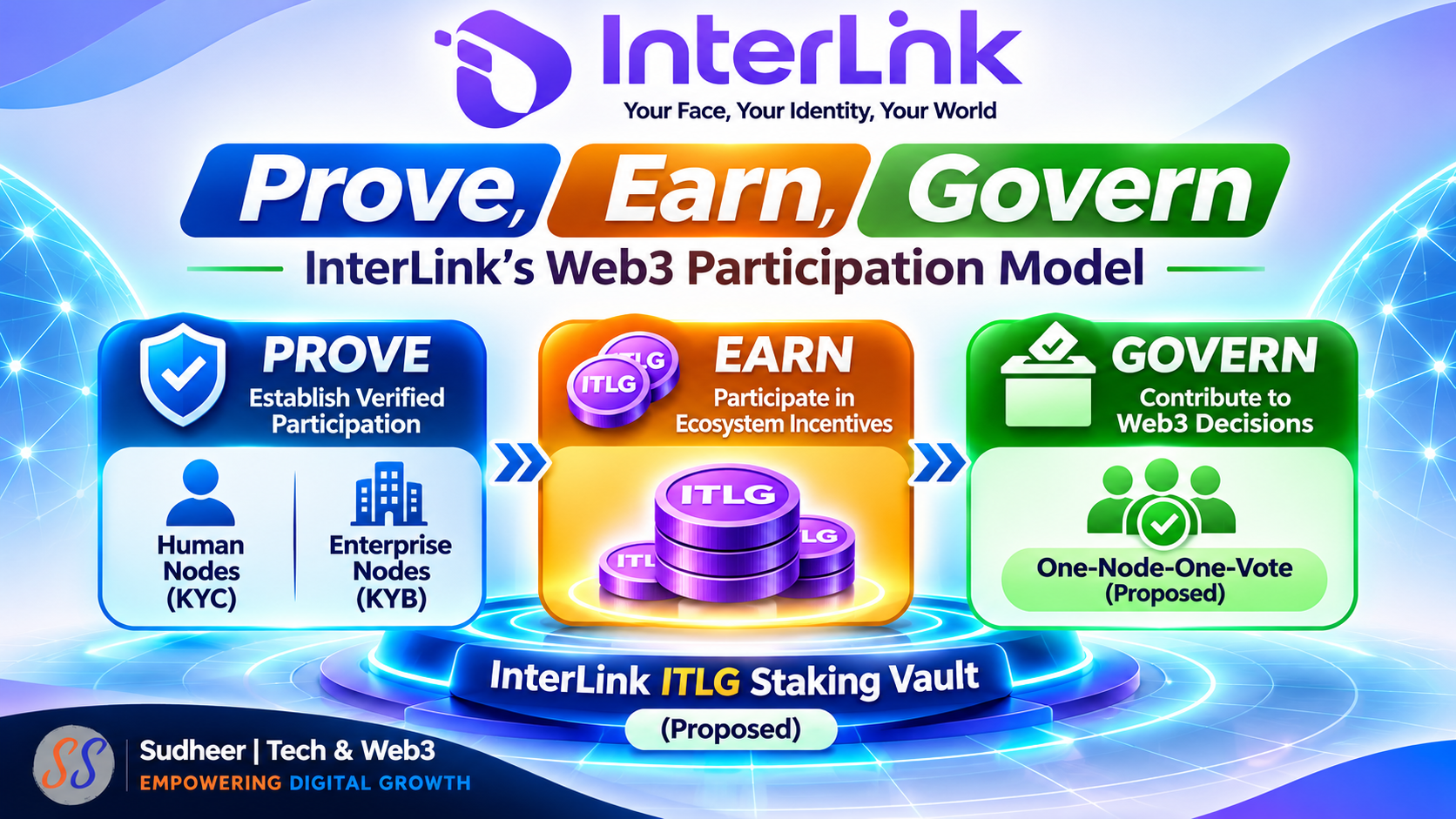
InterLink’s proposed Prove, Earn, Govern framework offers a way to understand how verified identity, ecosystem incentives, and community decision-making could work together.
The concept follows three connected principles:
- Prove: Establish that an eligible participant is a verified individual or business.
- Earn: Participate in ecosystem activities and potentially receive rewards under defined rules.
- Govern: Contribute to decisions that influence the network’s future.
InterLink’s proposed ITLG Staking Vault provides an example of this approach. It aims to connect verified individuals and institutional participants with staking opportunities and governance.
However, the proposed Vault’s final operating rules, reward mechanisms, and governance arrangements still require careful distinction from features already available in the wider InterLink ecosystem.
Let’s examine what each principle means and why it matters for Web3.
What Does Prove, Earn, Govern Mean in Web3?
Prove, Earn, Govern describes a participation model in which identity, incentives, and decision-making are connected.
In many blockchain networks, users can create wallets without identifying themselves. Their participation may depend primarily on wallet ownership, token balances, or transaction activity.
That model offers flexibility, but it can also create challenges for applications that want to recognize unique participants and support accountable governance.
InterLink’s approach emphasizes verified participation as a foundation for certain ecosystem activities.
The three principles address different questions:
| Principle | Main question | Intended purpose |
|---|---|---|
| Prove | Who is participating? | Establish eligible, verified identities |
| Earn | How can participants contribute? | Connect qualifying activity with potential incentives |
| Govern | How can participants influence decisions? | Support participation in ecosystem governance |
These principles are related, but they are not interchangeable. Completing identity verification does not automatically guarantee rewards or voting rights.
1. PROVE: Establishing Verified Participation
The first pillar is identity verification.
InterLink’s broader identity model emphasizes distinguishing genuine participants from duplicate or automated accounts.
Within the proposed ITLG Staking Vault framework, the announced design identifies two participation categories.
Human Nodes: Verification for Individuals
Human Nodes represent eligible individual participants.
Under the proposed Vault model, individuals would complete the required ITLG Know Your Customer (KYC) process before participating through verified wallets.
KYC generally establishes information about an individual and may involve identity documentation, verification checks, and additional compliance requirements.
In this context, the purpose is to associate participation with a verified person rather than relying solely on an anonymous wallet address.
Enterprise Nodes: Verification for Businesses
Enterprise Nodes represent eligible businesses and institutions.
These organizations would undergo Know Your Business (KYB) verification and use registered business wallets.
KYB generally examines an organization’s legal existence, registration information, ownership, and relevant authorization details.
This distinction matters because verifying an individual is not the same as establishing which legal entity controls a business wallet.
For a detailed comparison, read KYC vs. KYB in Web3: Human and Enterprise Nodes Explained.
Why Verification Matters
Verified participation could help a blockchain ecosystem establish clearer eligibility rules.
It may also support accountability in applications that depend on recognized individuals or organizations.
However, verification is not a complete security solution.
A verified wallet can still be compromised. A verified business can still act irresponsibly. A verified person may still attempt to abuse a system.
Projects therefore need additional safeguards, including wallet security, access controls, appropriate privacy protections, and transparent participation rules.
The key principle: Verification can establish who is eligible to participate, but it does not guarantee how that participant will behave.
2. EARN: Connecting Participation With Ecosystem Incentives
The second pillar concerns incentives.
Blockchain ecosystems often use rewards to encourage participation, provide network services, or support other defined activities.
InterLink has described several ways in which ITLG can relate to ecosystem participation, including Human Node activity, application use, and staking.
The proposed Vault introduces another potential participation mechanism.
How Would ITLG Staking Work?
Under the announced design, eligible participants would stake transferable ITLG according to the applicable Vault rules.
The proposal includes both individual and institutional participants.
InterLink has also discussed rewards associated with fees generated by activity across its ecosystem.
The intended relationship is straightforward: as applications and services are used, certain fees could contribute to the reward mechanisms defined by the protocol.
However, the existence of ecosystem activity does not establish a guaranteed reward amount or a predictable return.
The final Vault documentation must clarify the reward formula, eligible participants, distribution schedule, lock-up conditions, withdrawal rules, and associated risks.
What Are Dynamic Staking Rewards?
Dynamic rewards are incentives whose amounts can change based on the rules and conditions of a system.
Unlike a fixed promised return, a dynamic mechanism may depend on factors such as eligible staking activity, available reward allocations, and applicable ecosystem fees.
For the proposed ITLG Vault, the important point is that potential rewards should not be presented as guaranteed income.
Participants must also distinguish between different token states and reward mechanisms. ITLG, vITLG, and ITL should not be treated as interchangeable assets merely because they are related within InterLink’s broader token model.
The final protocol rules will determine how any conversion, allocation, or reward distribution works.
Why Real Ecosystem Activity Matters
A long-term blockchain participation model needs more than incentives.
It also needs applications that people and businesses find useful.
For example, an ecosystem might support digital identity, decentralized applications, payments, community services, or other functions.
When applications generate genuine demand, participation incentives may become more closely connected to actual network use.
However, a proposed fee-based reward mechanism is not proof of future revenue, token value, or financial sustainability.
The key principle: Earn should represent incentives governed by transparent rules, not an expectation of automatic profits.
For more context, see What Is the ITLG Staking Vault? Human Nodes vs. Enterprise Nodes.
3. GOVERN: Giving Participants a Role in Decision-Making
The third pillar is governance.
Governance describes how participants can influence decisions about a blockchain network, its applications, or its economic rules.
In decentralized systems, governance may involve proposals, voting, delegated authority, or other decision-making processes.
InterLink has discussed community participation in governance as part of its wider ecosystem vision.
What Is DAO Governance?
A decentralized autonomous organization, or DAO, is a governance structure that uses defined rules and often blockchain-based tools to coordinate decisions.
Depending on its design, participants may vote on matters such as:
- Protocol changes and upgrades.
- Community proposals.
- Ecosystem development priorities.
- Certain treasury or resource decisions.
- Participation and incentive rules.
Not every DAO uses the same voting model.
Some systems give more influence to larger token holders. Others attempt to incorporate identity, delegation, or additional eligibility requirements.
What Does One-Node-One-Vote Mean?
The Daily Task 85 Vault proposal describes a one-node-one-vote governance vision.
Conceptually, this would mean eligible nodes receive voting representation according to node-based rules rather than simply increasing their votes in proportion to the number of tokens held.
However, the exact meaning depends on how the system defines a node, verifies eligibility, prevents duplicates, and treats individuals and organizations.
It is particularly important to distinguish this proposed model from other InterLink governance descriptions that refer to token-weighted voting or combinations of token stake and identity weight.
Those descriptions should not be assumed to represent one identical, finalized governance mechanism.
Until the relevant governance contracts and rules are published, one-node-one-vote is best understood as a stated design objective for the proposed model.
Why Governance Needs More Than Verification
Even when participants are verified, a governance system can face challenges.
For example:
- Some participants may not vote.
- Organizations may have complex ownership structures.
- Participants may attempt to coordinate voting power.
- Proposals may be difficult for ordinary users to evaluate.
- Security weaknesses may affect voting infrastructure.
A credible governance system needs clear eligibility rules, transparent proposals, reliable voting processes, and appropriate accountability.
The key principle: Governance should provide meaningful participation through clearly defined rules, not simply display a voting button.
How Prove, Earn, and Govern Work Together
The three pillars can be understood as a connected process.
Step 1: Prove
An eligible person or organization completes the applicable verification requirements.
Step 2: Earn
The participant engages in qualifying ecosystem activities and may become eligible for incentives under the relevant rules.
Step 3: Govern
The participant may contribute to governance decisions if the applicable eligibility and voting conditions are satisfied.
This model aims to connect identity, participation, and influence.
However, it should not be interpreted as an automatic sequence in which verification guarantees staking access, staking guarantees rewards, or rewards guarantee voting rights.
Each stage depends on the actual implementation.
Human Nodes and Enterprise Nodes: One Ecosystem, Different Participants
One distinctive aspect of InterLink’s proposed Vault is the inclusion of both individuals and organizations.
Human Nodes would represent verified individuals.
Enterprise Nodes would represent verified businesses and institutions.
Both categories could participate in the wider staking ecosystem, although their verification requirements and operational obligations would differ.
This approach could create opportunities for individual and institutional participation within a common framework.
At the same time, it raises important questions about governance eligibility, business control, privacy, wallet management, and institutional influence.
The final rules must address those questions before the model’s practical effectiveness can be assessed.
The Difference Between Verified Identity and Verified Tokens
Another important distinction is the meaning of the word verified.
Identity verification generally concerns the person or organization behind an account.
Token verification, where used as a separate protocol status, concerns the classification or eligibility of tokens under specific system rules.
InterLink has also described a proposed staking mechanism through which staked ITLG may have a chance to receive a separate Verified status.
That potential token status should not be confused with KYC or KYB identity verification.
The announced randomized mechanism does not guarantee that staked tokens will receive Verified status.
Keeping these concepts separate helps participants avoid misunderstandings about eligibility, staking, and rewards.
What Are the Risks and Limitations?
The Prove, Earn, Govern framework presents an interesting model, but its success depends on implementation.
Several questions remain important.
Privacy
How will identity information be collected, stored, protected, and retained?
Staking Security
What safeguards will protect staked assets and related smart contracts?
Reward Transparency
How will participants verify reward calculations and distributions?
Governance Fairness
How will the system prevent duplicate participation, concentration of influence, or voting abuse?
Regulatory Requirements
How will individual and institutional participation comply with applicable laws and requirements?
Operational Reliability
Will the applications, verification systems, and governance mechanisms function reliably as participation grows?
These are practical considerations rather than reasons to assume the proposed model will succeed or fail.
Frequently Asked Questions
What does Prove, Earn, Govern mean in InterLink?
It describes a participation concept connecting verified identity, potential ecosystem incentives, and governance. The exact rights and requirements depend on the relevant InterLink mechanisms.
What is the Prove stage?
Prove refers to establishing eligible participant identity. In the proposed Vault, Human Nodes would use KYC, while Enterprise Nodes would use KYB.
Does completing KYC guarantee ITLG staking rewards?
No. Verification does not guarantee access to a particular staking program, reward amount, or financial return.
Can businesses participate in InterLink staking?
The proposed Vault includes Enterprise Nodes for eligible businesses and institutions, subject to applicable verification and participation rules.
What is one-node-one-vote governance?
It is a proposed governance approach in which voting representation is associated with eligible nodes. Its final rules and relationship to other InterLink voting mechanisms require clarification.
Is the ITLG Staking Vault already operational?
InterLink has announced ITLG Mainnet developments, but the described Vault mechanics should not be assumed to be fully operational without confirmation of their specific deployment and availability.
Is ITLG the same as ITL?
No. InterLink describes ITLG and ITL as distinct tokens with different intended roles. Their functions, issuance, and governance relationships should be evaluated separately.
Final Thoughts
Prove, Earn, Govern provides a useful framework for understanding InterLink’s approach to verified Web3 participation.
Prove focuses on establishing participant identity.
Earn focuses on incentives connected to qualifying ecosystem activity.
Govern focuses on giving eligible participants a role in decision-making.
The broader ambition is to build a blockchain ecosystem in which identity, participation, and governance reinforce one another.
Whether that ambition succeeds will depend on clear rules, practical applications, privacy safeguards, technical security, and transparent execution.
As InterLink develops its staking and governance infrastructure, participants should rely on current official documentation rather than treating proposed mechanisms as guaranteed outcomes.
Continue Exploring
- What Is the ITLG Staking Vault? Human Nodes vs. Enterprise Nodes
- KYC vs. KYB in Web3: Human and Enterprise Nodes Explained
Official References
- InterLink Tokenomics 2026
- ITL vs. ITLG: InterLink’s Dual-Token Model
- ITLG Mainnet Era: One-Step KYC for On-Chain ITLG
- InterLink Official Announcements
Written by Sudheer Singh Banoth, InterLink Tier 3 Ambassador. This independent educational article discusses both existing ecosystem developments and proposed features. It is not financial, investment, or legal advice.
#InterLink #ITLG #ITL