What if an ordinary individual could participate in a blockchain network alongside some of the world’s largest corporations?
InterLink’s proposed Human Node model introduces a vision in which verified individuals and enterprises could participate within the same blockchain ecosystem.
According to InterLink’s Daily Task 86 announcement, Linkers who receive their ITLG in the upcoming phase would be able to stake it and participate in the network as Human Nodes, subject to identity verification and wallet eligibility requirements.
The announcement also describes an ambitious objective: Human Nodes would enjoy the same rights and benefits as Enterprise Nodes, even when those enterprises are large, publicly listed corporations.
This approach places individual participation at the center of InterLink’s broader decentralization strategy.
However, understanding how the proposed model works requires distinguishing its announced objectives from features that are already operational.
What Are InterLink Human Nodes?
InterLink Human Nodes are a proposed category of network participants representing verified individuals.
Unlike participation models based solely on wallet ownership, the announced Human Node framework connects individual identity with eligibility to participate in the proposed ITLG staking ecosystem.
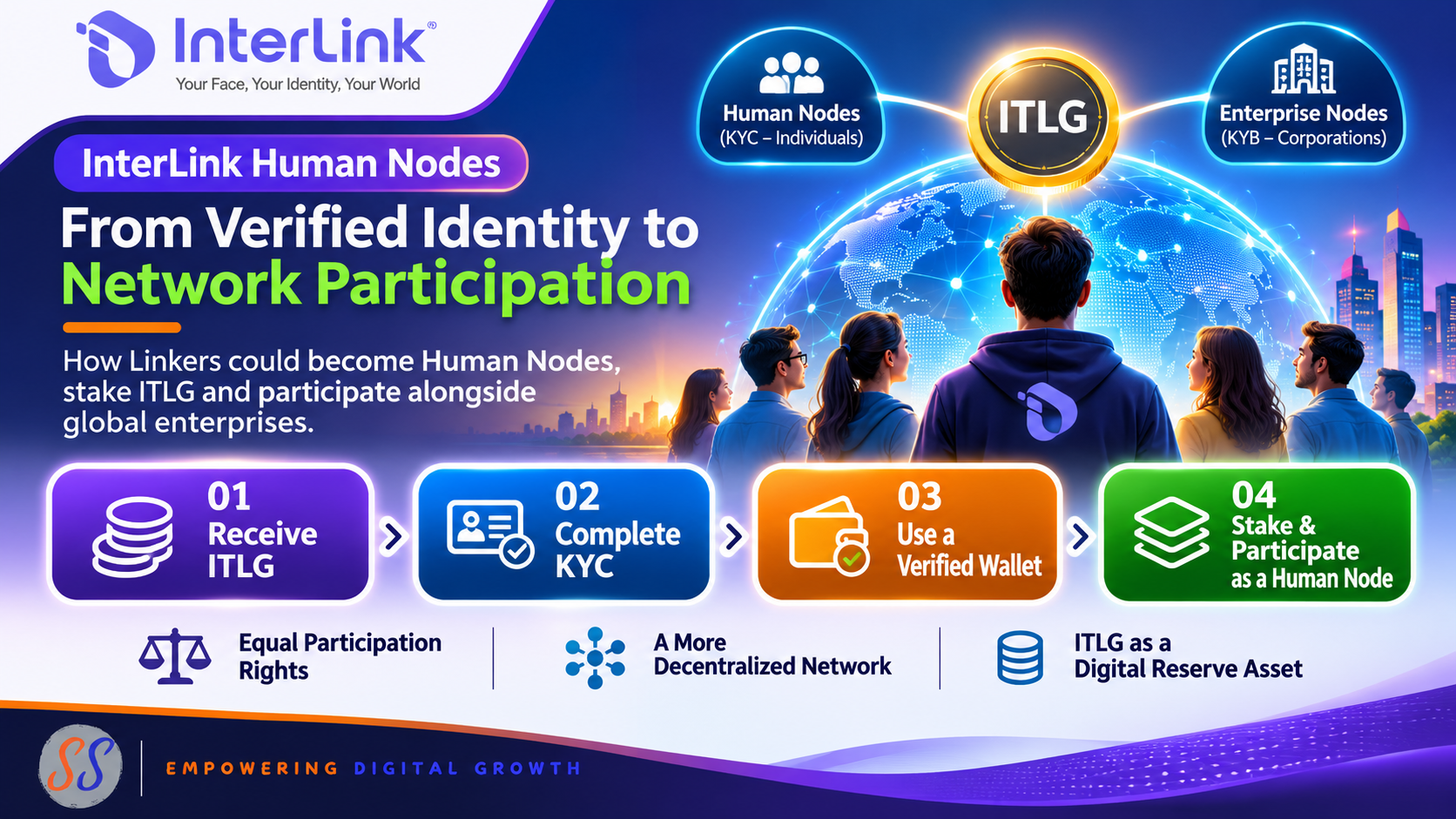
Under the upcoming model described by InterLink, a Linker would need to:
- Receive eligible ITLG.
- Successfully complete the required KYC verification.
- Use a wallet associated with their verified identity.
- Stake eligible ITLG according to the applicable network rules.
The announcement identifies these requirements as the foundation for Human Node participation.
However, the complete technical requirements, staking thresholds, activation procedures, and other operational conditions still need confirmation through final implementation documentation.
From Linker to Human Node: Understanding the Journey
The proposed Human Node model represents a transition from individual ecosystem membership toward a more structured form of network participation.
We can understand this transition through four stages.
Stage 1: Receiving ITLG
The first stage involves Linkers receiving ITLG during the upcoming phase described in the announcement.
ITLG forms part of InterLink’s broader digital asset ecosystem.
However, receiving or accumulating ITLG should not automatically be interpreted as activating a Human Node.
Additional eligibility requirements would apply before a participant could use the proposed staking mechanism.
The announcement does not establish a specific distribution date or guarantee that every Linker will receive the same amount of eligible ITLG.
Stage 2: Completing KYC Verification
The second stage involves Know Your Customer, commonly known as KYC.
KYC establishes information about an individual’s identity through an applicable verification process.
InterLink’s Daily Task 86 announcement specifically states that Linkers must successfully pass KYC to qualify for Human Node participation.
This requirement connects the proposed staking ecosystem with verified individual identities.
It also highlights an important distinction between simply owning a blockchain wallet and being recognized as an eligible participant under a particular network’s rules.
For a more detailed explanation of individual and business verification, read KYC vs. KYB in Web3: Human and Enterprise Nodes Explained.
Stage 3: Using a KYC-Associated Wallet
Blockchain wallets allow users to manage digital assets and interact with compatible applications.
However, a wallet address alone does not necessarily establish the identity of the person controlling it.
Under InterLink’s announced Human Node model, only wallets associated with KYC-verified users would be eligible for staking.
This introduces a relationship between verified identity and wallet eligibility.
Such an approach could help establish accountability within the proposed participation framework.
Nevertheless, identity verification does not guarantee wallet security. Participants must still protect their credentials, avoid phishing attempts, and follow appropriate security practices.
The final technical documentation should explain how wallet association, ownership verification, recovery, and eligibility checks will work.
Stage 4: Staking ITLG and Participating as a Human Node
After meeting the applicable identity and wallet requirements, eligible Linkers would be able to stake ITLG and participate as Human Nodes under the proposed model.
Staking generally involves committing digital assets according to the rules of a blockchain protocol or application.
Depending on the implementation, staking may involve participation incentives, restrictions on asset movement, or other obligations.
InterLink’s proposed Staking Vault describes a shared ecosystem involving both Human Nodes and Enterprise Nodes.
However, participants should not assume that staking guarantees rewards, a particular return, or unrestricted access to their assets.
The final staking rules will determine the actual requirements, benefits, restrictions, and risks.
Read our complete guide to the proposed ITLG Staking Vault for additional context.
Human Node Participation at a Glance
| Stage | Proposed requirement | Purpose |
|---|---|---|
| Receive | Obtain eligible ITLG | Establish the asset required for staking |
| Verify | Successfully complete KYC | Establish individual identity |
| Associate | Use an eligible KYC-associated wallet | Connect verified identity with wallet participation |
| Stake | Meet applicable ITLG staking requirements | Participate under the proposed Human Node framework |
These stages summarize the announced participation concept. They should not be treated as a finalized technical onboarding procedure.
Why Human Nodes Matter for Blockchain Participation
Many blockchain ecosystems allow users to participate through digital wallets without necessarily establishing their real-world identities.
This permissionless approach offers important advantages, including accessibility and flexibility.
However, certain applications may need additional mechanisms to recognize eligible individuals, discourage duplicate participation, or support identity-based governance.
InterLink’s Human Node concept addresses this challenge by placing verified individuals within its proposed participation framework.
Rather than relying exclusively on the amount of capital a participant controls, the announced vision emphasizes the role of verified people within the ecosystem.
This could create opportunities for individuals to participate in a network that also includes businesses and institutions.
However, the effectiveness of this approach will depend on how the final system handles identity uniqueness, eligibility, privacy, and operational security.
Can Ordinary Individuals Participate Alongside Large Corporations?
One of the most significant statements in the Daily Task 86 announcement concerns the relationship between Human Nodes and Enterprise Nodes.
InterLink states that Human Nodes would enjoy the same rights and benefits as Enterprise Nodes, including situations where participating enterprises are KYB-verified corporations listed on Nasdaq or the New York Stock Exchange.
This is an important part of the project’s announced vision.
A large corporation may possess considerably more financial resources than an ordinary individual. Nevertheless, InterLink’s proposed model aims to recognize verified individuals as meaningful participants within the same ecosystem.
This does not necessarily mean that every individual and enterprise would receive identical financial rewards.
Actual reward amounts, staking conditions, voting eligibility, and other benefits would depend on the final protocol rules.
Furthermore, the announcement’s reference to Nasdaq and NYSE-listed corporations describes the intended scope of the model. It does not confirm that specific publicly listed companies have already joined the network or acquired ITLG.
Human Nodes and the Prove, Earn, Govern Framework
The Human Node concept also connects with InterLink’s previously described Prove, Earn, Govern framework.
Prove
Establish eligible participation through identity verification.
For Human Nodes, this involves the applicable KYC requirements and association with an eligible wallet.
Earn
Participate in qualifying ecosystem activities and potentially receive incentives according to the relevant rules.
The proposed ITLG Staking Vault provides one example of how such participation could work.
Govern
Contribute to ecosystem decisions where the applicable governance rules permit participation.
InterLink has described a proposed one-node-one-vote governance vision, although its final implementation requires further clarification.
Together, these principles illustrate how identity, participation, incentives, and governance could become connected.
For a complete explanation, read Prove, Earn, Govern: InterLink’s Web3 Participation Model.
How Human Nodes Could Support Global Decentralization
InterLink’s Daily Task 86 announcement identifies global decentralization as one of its fundamental objectives.
The project aims to establish a blockchain powered by millions of verified Human Nodes worldwide.
A geographically distributed community of participants could help broaden ecosystem involvement beyond a small number of organizations or regions.
However, decentralization involves more than participant numbers.
A blockchain network’s actual decentralization also depends on factors such as:
- Distribution of infrastructure and operational control.
- Governance authority and voting arrangements.
- Concentration of assets and influence.
- Independence of network participants.
- Accessibility of network services.
- Technical architecture and security.
Therefore, millions of verified Human Nodes would represent an important participation objective, but participant numbers alone would not establish that InterLink is among the world’s most decentralized blockchains.
That assessment would require measurable evidence from the operational network.
What Should Linkers Understand Before Becoming Human Nodes?
As the proposed participation model develops, Linkers should focus on understanding the requirements rather than relying on assumptions about future benefits.
Identity and Privacy
Review how identity verification works and how personal information is protected.
Only submit sensitive information through verified official channels.
Wallet Security
Understand how eligible wallets are associated with verified identities.
Protect recovery phrases, private keys, passwords, and authentication credentials.
Never share sensitive wallet information with someone claiming to offer staking activation or guaranteed rewards.
Staking Conditions
Review the final requirements for minimum stakes, asset restrictions, withdrawal conditions, and eligibility.
Do not assume that proposed staking features are available before their official activation.
Reward Expectations
Potential staking incentives should not be treated as guaranteed income.
Reward mechanisms may change depending on protocol rules, available allocations, and ecosystem conditions.
Governance Rights
Understand the difference between becoming a verified participant and qualifying for specific governance rights.
The final governance documentation should explain how participants can submit proposals, vote, or otherwise contribute to network decisions.
Frequently Asked Questions
What is a Human Node in InterLink?
A Human Node is a proposed network participation category for eligible, KYC-verified individuals who stake ITLG through associated wallets under the announced framework.
Can every Linker become a Human Node?
The announcement describes Human Node participation for Linkers who receive eligible ITLG and successfully complete the required KYC verification. Final eligibility conditions remain subject to implementation.
Is KYC mandatory for Human Node staking?
Yes, according to the Daily Task 86 announcement. Linkers must successfully pass KYC, and only wallets associated with KYC-verified users would qualify for the proposed staking mechanism.
Can Human Nodes participate alongside Enterprise Nodes?
Yes. InterLink’s announced model aims to enable verified individuals and enterprises to participate within the same ecosystem.
Will Human Nodes receive the same benefits as large corporations?
The announcement describes equal rights and benefits for Human Nodes and Enterprise Nodes as an objective. However, the final rules must clarify how those rights and benefits operate in practice.
Does becoming a Human Node guarantee ITLG rewards?
No. Verification and staking participation do not guarantee a particular reward amount, financial return, or token value.
Are Nasdaq or NYSE-listed companies already participating?
The Daily Task 86 announcement refers to such corporations as potential participants within the proposed model. It does not identify confirmed participating companies.
Is the Human Node staking mechanism already available?
The announcement describes an upcoming phase. Participants should consult current official InterLink announcements and implementation documentation to confirm availability.
Final Thoughts
InterLink’s proposed Human Node framework presents a vision in which verified individuals could participate alongside enterprises within a shared blockchain ecosystem.
The concept connects eligible ITLG ownership, identity verification, associated wallets, and staking participation.
Its broader ambition is to give ordinary individuals a meaningful role in a globally distributed network.
However, achieving this vision requires more than attracting participants. It requires transparent eligibility rules, secure infrastructure, privacy protections, credible governance, and sustainable ecosystem development.
For Linkers, the most important step is to understand the proposed participation requirements and follow verified official updates as the system develops.
Continue Exploring
- What Is the ITLG Staking Vault? Human Nodes vs. Enterprise Nodes
- KYC vs. KYB in Web3: Human and Enterprise Nodes Explained
- Prove, Earn, Govern: InterLink’s Web3 Participation Model
Source and Further Information
This article is based on InterLink’s Ambassador Daily Task 86 announcement, dated November 26, 2026.
Follow InterLink’s official website and verified announcement channels for further information about implementation and participation requirements.
Written by Sudheer Singh Banoth, InterLink Tier 3 Ambassador. This independent educational article discusses announced objectives and proposed network functionality. It does not constitute financial, investment, or legal advice.
#InterLink #ITLG #ITL