Imagine an ordinary individual participating in the same blockchain economy as a multinational corporation, with the same fundamental participation rights despite their vastly different financial resources.
InterLink’s proposed equal participation model explores this possibility by bringing verified individuals and qualified enterprises into a shared digital ecosystem.
Through its proposed ITLG Staking Vault, InterLink aims to establish a framework where Human Nodes and Enterprise Nodes can participate alongside one another.
The concept introduces an important discussion about the future of Web3. Should meaningful participation depend primarily on financial resources, or should verified individuals and businesses have opportunities to contribute under a common framework?
Understanding InterLink’s approach requires examining the relationship between digital identity, institutional participation, economic incentives, and blockchain governance.
What Is InterLink’s Equal Participation Model?
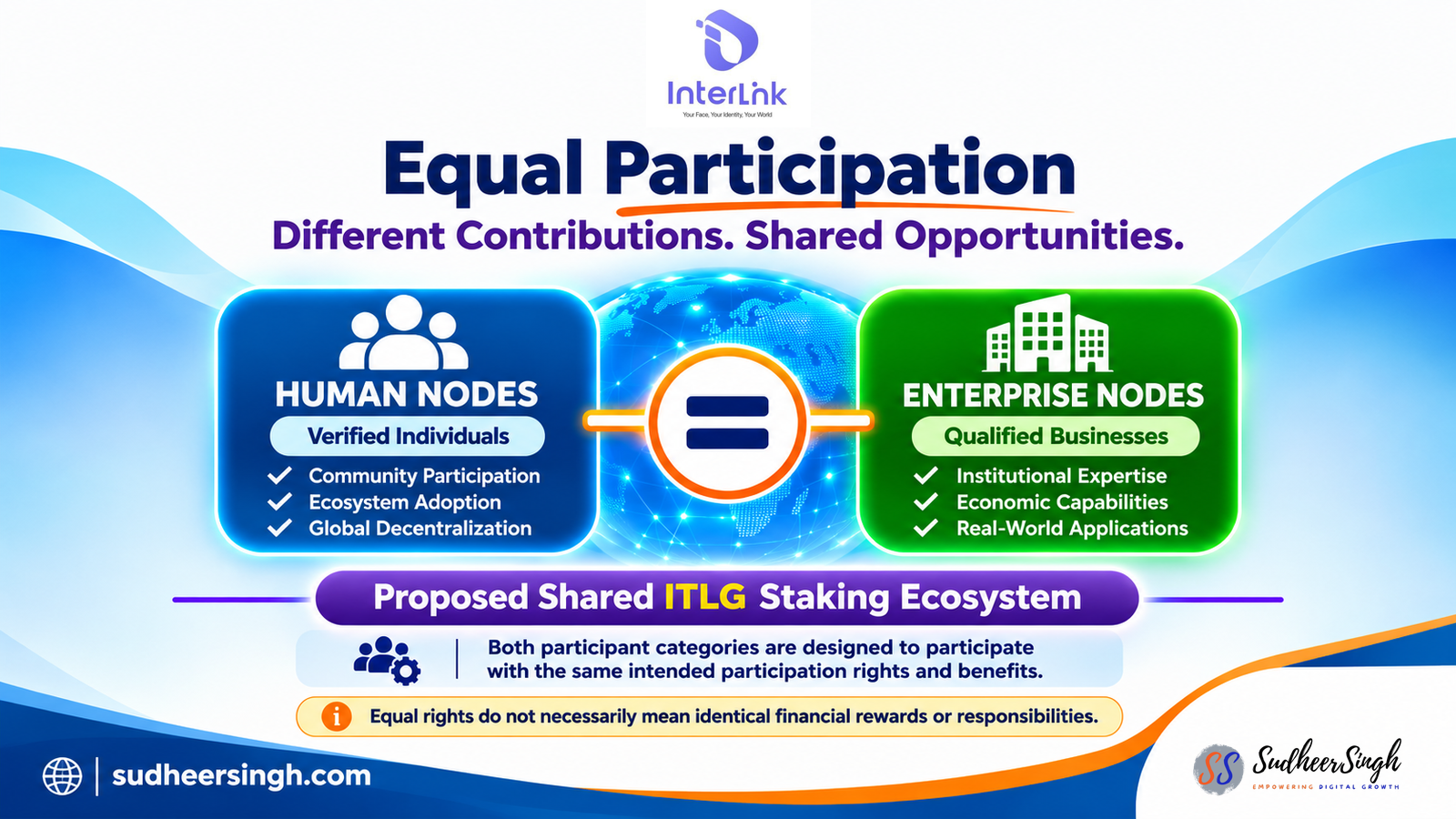
InterLink’s equal participation model is a proposed framework that brings two distinct categories of participants into a shared blockchain economy:
- Human Nodes: Eligible individuals who complete identity verification and meet the applicable participation requirements.
- Enterprise Nodes: Qualified businesses and institutions that participate under their verified legal identities.
Both categories are designed to participate through the proposed ITLG Staking Vault.
Although individuals and enterprises possess different resources and capabilities, InterLink’s stated vision is for Human Nodes to enjoy the same rights and benefits as Enterprise Nodes.
This approach could allow ordinary individuals to participate alongside large organizations, including potentially publicly listed corporations.
However, equal participation rights do not necessarily mean identical financial rewards, operational responsibilities, or qualification requirements.
The final implementation will determine how these principles translate into practical participation.
Why Equal Participation Matters in Web3
Blockchain technology has expanded access to digital assets, financial services, decentralized applications, and new forms of economic participation.
However, access to blockchain technology does not automatically create equal influence.
In some blockchain ecosystems, participants with larger token holdings can exercise greater voting power or economic influence. While these mechanisms may encourage financial commitment, they can also create challenges related to the concentration of power.
Other blockchain projects explore alternative approaches, including identity-based governance, delegated voting, and community-oriented participation models.
InterLink’s proposed framework introduces verified identity as an important foundation for participation.
Instead of defining a participant solely through wallet ownership or financial resources, the model aims to recognize the individuals and organizations behind eligible wallets.
This creates an opportunity to explore a more inclusive digital economy where both people and businesses can contribute meaningfully.
Human Nodes: The Foundation of Community Participation
Human Nodes represent verified individuals within InterLink’s proposed network participation model.
Eligible Linkers would receive transferable ITLG, successfully complete Know Your Customer (KYC) verification, and use wallets associated with their verified identities.
They could then participate in the proposed staking ecosystem, subject to the applicable requirements.
However, the potential contribution of Human Nodes extends beyond staking.
A globally distributed community of verified individuals could support:
- Adoption of decentralized applications.
- Community development and education.
- Feedback on ecosystem products and services.
- Participation in digital economic activities.
- Governance, where eligible under the final rules.
The value of individual participation comes not only from financial resources but also from knowledge, creativity, engagement, and practical use of ecosystem services.
For a detailed explanation of the proposed participation journey, read InterLink Human Nodes: From Verified Identity to Network Participation.
Enterprise Nodes: Bringing Business Capabilities Into Web3
Enterprise Nodes represent qualified businesses and institutions within InterLink’s proposed economic framework.
Unlike individual participants, businesses have organizational structures, legal responsibilities, financial resources, and operational capabilities.
Consequently, institutional participation requires a different verification and qualification process.
InterLink’s proposed Enterprise Node framework extends beyond simply acquiring and staking ITLG.
Expected qualification considerations include:
- Know Your Business (KYB) verification of legal entities and beneficial owners.
- Business reputation and operational history.
- Financial capabilities and organizational credibility.
- Long-term staking commitments with publicly verifiable records.
- Transparency regarding token sources, custody, and ownership.
- Potential contributions to ecosystem development, governance, or network operations.
Publicly listed companies and businesses with independently audited financial statements are identified as potential priority participants within this vision.
These proposed requirements aim to introduce greater accountability into institutional blockchain participation.
Qualified enterprises could also contribute business infrastructure, commercial expertise, products, services, and real-world applications.
Nevertheless, the final admission requirements and operational responsibilities remain subject to implementation.
Human Nodes and Enterprise Nodes: Different Roles, Shared Ecosystem
Individuals and enterprises bring different capabilities to a blockchain economy.
Human Nodes could contribute community strength, user adoption, and geographically distributed participation.
Enterprise Nodes could introduce business resources, institutional expertise, commercial applications, and economic activity.
InterLink’s proposed model aims to connect these complementary contributions within a common framework.
| Participation factor | Human Nodes | Enterprise Nodes |
|---|---|---|
| Participant identity | Verified individual | Qualified legal entity |
| Verification | KYC | KYB and additional qualification |
| Wallet | KYC-associated wallet | Registered business wallet |
| Economic participation | Eligible ITLG staking | Eligible ITLG staking |
| Staking framework | Proposed shared ITLG Vault | Proposed shared ITLG Vault |
| Primary contribution | Community participation and decentralization | Institutional capabilities and business development |
| Participation rights | Proposed equal rights and benefits | Proposed equal rights and benefits |
The important distinction is that equal participation does not require identical contributions.
Both participant categories could support the same ecosystem while performing different economic and operational roles.
For more information about their verification requirements, explore KYC vs. KYB in Web3: Human and Enterprise Nodes Explained.
Could Individuals Participate Alongside Global Corporations?
One of the most interesting aspects of InterLink’s vision is the possibility of verified individuals participating alongside major international enterprises.
Consider a hypothetical example.
An individual completes KYC verification, receives eligible ITLG, and satisfies the applicable Human Node participation requirements.
Meanwhile, a publicly listed corporation completes KYB verification, satisfies the Enterprise Node qualification criteria, and makes the required staking commitment.
Under InterLink’s proposed framework, both could participate within the same ITLG staking ecosystem.
The corporation may possess significantly greater financial resources, infrastructure, and commercial capabilities. However, the announced vision is for both participant categories to enjoy the same fundamental participation rights and benefits.
This illustrates how identity-based participation could connect individuals and institutions within a shared digital economy.
InterLink’s ambition extends to potential participation by corporations listed on major stock exchanges, including Nasdaq and the New York Stock Exchange.
However, this ambition should not be interpreted as confirmation that specific publicly listed companies have already joined InterLink or acquired ITLG.
Actual institutional adoption would require separate confirmation.
Equal Participation Rights vs. Equal Financial Rewards
Equal participation rights and equal financial rewards are two different concepts.
Participation rights concern how eligible individuals and organizations are recognized within an ecosystem.
Financial rewards concern how economic incentives are calculated and distributed.
For example, two participants may have access to the same staking mechanism while committing different amounts of digital assets.
Their potential rewards could therefore differ according to the applicable reward formula.
InterLink’s proposed ITLG Staking Vault describes a shared staking pool without a separate institutional reward rate merely because a participant is a business.
However, this does not guarantee identical total rewards for all participants.
Actual incentives may depend on factors such as:
- Eligible staking amounts.
- Applicable staking conditions.
- Available reward allocations.
- Relevant ecosystem fees.
- Other requirements defined by the protocol.
The final economic rules will determine how these factors affect reward distribution.
Therefore, equal participation should be understood as a principle of inclusion rather than a promise of equal financial outcomes.
Read What Is the ITLG Staking Vault? Human Nodes vs. Enterprise Nodes for a broader explanation of the proposed staking framework.
The Role of Governance in Equal Participation
Governance determines how participants can influence decisions within a blockchain ecosystem.
Some decentralized governance models distribute voting power according to token holdings. Others explore approaches based on verified identity, delegation, or defined participant roles.
InterLink has described a proposed one-node-one-vote governance vision within its Staking Vault framework.
Conceptually, this approach could recognize eligible nodes as governance participants rather than determining influence exclusively through financial holdings.
For Human Nodes, such a framework could provide opportunities to contribute to ecosystem decisions alongside institutional participants.
However, a credible governance system requires more than identity verification.
Several important questions remain:
How Is Voting Eligibility Established?
The network must define which Human Nodes and Enterprise Nodes qualify for governance participation.
How Is Duplicate Participation Prevented?
Appropriate safeguards are necessary to prevent participants from obtaining multiple voting identities or improperly concentrating influence.
How Are Corporate Relationships Managed?
Businesses may operate through subsidiaries, related entities, shareholders, and complex ownership structures. Governance rules must clarify how these relationships affect participation.
How Are Decisions Implemented?
A transparent governance system requires clear processes for submitting proposals, evaluating information, conducting votes, and implementing approved decisions.
These considerations will determine whether the proposed governance framework can support meaningful and accountable participation.
For a deeper understanding of the relationship between identity, incentives, and governance, read Prove, Earn, Govern: InterLink’s Web3 Participation Model.
How Individuals and Enterprises Could Create Value Together
A blockchain economy becomes more useful when its participants contribute complementary capabilities.
Individuals create demand for products and services. Businesses can develop and deliver those products and services.
Connecting these groups within a shared digital ecosystem could create opportunities for economic collaboration.
Individuals Could Drive Ecosystem Adoption
A growing community of verified users could support demand for digital payments, decentralized applications, identity services, and other blockchain-based products.
Active users could also provide valuable feedback that helps developers and businesses improve their services.
Enterprises Could Introduce Real-World Utility
Qualified businesses could contribute commercial applications, financial services, payment infrastructure, and integrations with decentralized applications.
Potential opportunities could also include real-world asset tokenization and other blockchain-based business services.
These opportunities remain dependent on technical development, regulatory requirements, and actual institutional adoption.
A Shared Ecosystem Could Strengthen Network Effects
As more businesses introduce useful services, additional users may become interested in participating.
A growing community of active users could, in turn, make the ecosystem more attractive to businesses.
This relationship is known as a network effect.
If supported by genuine demand and reliable infrastructure, such a cycle could contribute to long-term ecosystem development.
However, network effects do not emerge automatically. They depend on whether the ecosystem delivers practical value to its participants.
Could Equal Participation Support Greater Decentralization?
InterLink’s long-term vision includes a blockchain ecosystem supported by millions of verified Human Nodes worldwide.
The participation of individuals across different geographic regions could broaden community involvement and reduce dependence on a limited group of economic participants.
However, decentralization involves more than the number of registered or verified users.
A blockchain network’s actual decentralization also depends on:
- Distribution of technical infrastructure.
- Concentration of governance authority.
- Distribution of economic influence.
- Independence of network operators.
- Accessibility of network services.
- Control over protocol development and upgrades.
A network may have millions of users while important infrastructure or decisions remain concentrated among relatively few entities.
Therefore, the proposed Human Node model should be evaluated alongside InterLink’s eventual technical architecture and governance implementation.
Equal participation could support decentralization, but its actual effectiveness will require measurable evidence.
Equal Rights Do Not Require Identical Responsibilities
Individuals and enterprises operate under different legal and economic circumstances.
An individual may primarily need to satisfy identity verification, wallet security, and applicable staking requirements.
A business may also need to address corporate authorization, beneficial ownership, financial reporting, asset custody, and regulatory compliance.
These additional requirements reflect the complexity of institutional participation.
For example, an enterprise holding digital assets may need internal policies governing who can authorize transactions, how assets are stored, and how ownership is documented.
Such responsibilities do not necessarily conflict with the principle of equal participation.
Instead, they highlight the importance of designing a framework that recognizes different participant roles while maintaining appropriate accountability.
What Will Determine the Success of InterLink’s Model?
The long-term effectiveness of InterLink’s proposed equal participation model will depend on several practical factors.
Transparent participation rules: Individuals and businesses need clear information about eligibility, rights, responsibilities, staking conditions, and restrictions.
Credible identity verification: KYC and KYB mechanisms must establish appropriate participant identities while protecting sensitive personal and business information.
Meaningful governance: Eligible participants need clearly defined opportunities to influence ecosystem decisions.
Real-world utility: A sustainable digital economy requires useful applications and services rather than depending exclusively on staking incentives.
Economic sustainability: Reward mechanisms must operate under transparent rules supported by appropriate economic resources.
Institutional accountability: Participating enterprises should meet suitable standards for qualification, transparency, and operational responsibility.
These factors will ultimately determine whether the proposed framework delivers meaningful opportunities for individuals and businesses.
Frequently Asked Questions
What is InterLink’s equal participation model?
It is a proposed framework in which verified Human Nodes and qualified Enterprise Nodes would participate within a shared blockchain economy with the same announced participation rights and benefits.
Can an ordinary individual participate alongside a large corporation?
That is part of InterLink’s stated vision. Eligible individuals and qualified enterprises would participate under their respective verification and participation requirements.
Do Human Nodes and Enterprise Nodes use the same Staking Vault?
According to the proposed framework, both categories are designed to participate within a shared ITLG staking ecosystem.
Does equal participation guarantee identical staking rewards?
No. Equal participation rights do not necessarily mean identical financial rewards. Actual incentives would depend on the applicable staking conditions and final reward calculations.
Are Nasdaq-listed or NYSE-listed companies already participating in InterLink?
InterLink’s vision includes potential participation by publicly listed corporations. However, this does not establish that specific companies have already joined the network or acquired ITLG.
Will Human Nodes and Enterprise Nodes have equal voting power?
InterLink has described a proposed one-node-one-vote governance vision. The final voting rights, eligibility conditions, and governance procedures require further implementation details.
Why do Enterprise Nodes have additional qualification requirements?
Businesses have more complex ownership, authorization, financial, and operational structures than individuals. Additional qualification requirements are intended to support institutional transparency and accountability.
Is InterLink’s equal participation model already operational?
The framework discussed in this article describes proposed participation mechanisms and long-term objectives. Readers should consult current official InterLink documentation to confirm the availability of specific features.
Final Thoughts
InterLink’s proposed equal participation model presents an interesting approach to connecting individuals and enterprises within a shared blockchain economy.
Human Nodes could contribute community participation, adoption, and decentralization. Enterprise Nodes could contribute institutional capabilities, business expertise, and real-world applications.
The broader ambition is to create an ecosystem where financial size alone does not define the importance of a participant.
However, equal participation should not be confused with identical financial rewards or responsibilities.
The effectiveness of this model will depend on transparent rules, credible identity verification, meaningful governance, sustainable economics, and practical applications.
Ultimately, the success of an inclusive blockchain economy will be measured by the real opportunities it creates for the people and businesses participating in it.
Further Reading
- InterLink Human Nodes: From Verified Identity to Network Participation
- KYC vs. KYB in Web3: Human and Enterprise Nodes Explained
- Prove, Earn, Govern: InterLink’s Web3 Participation Model
- What Is the ITLG Staking Vault? Human Nodes vs. Enterprise Nodes
For current project developments and implementation announcements, visit the official InterLink website.
Author Disclosure: This article provides independent educational commentary on blockchain technology and InterLink’s proposed ecosystem developments. It does not constitute financial, investment, or legal advice.