Decentralization is one of the most important principles behind blockchain technology. Yet building a genuinely decentralized network requires more than distributing digital assets or attracting millions of users.
It requires a meaningful distribution of participation, decision-making authority, economic opportunities, and technical control.
InterLink’s proposed Human Node model introduces an interesting approach to this challenge by connecting verified human identity with blockchain participation.
The project’s long-term ambition is to establish a globally decentralized blockchain ecosystem supported by millions of verified individuals.
But how could Human Nodes contribute to that objective? And what would it take for InterLink to translate widespread human participation into genuine decentralization?
What Does Decentralization Mean in Blockchain?
Decentralization refers to the distribution of authority, control, and responsibilities across multiple independent participants rather than concentrating them within a single organization or governing entity.
Traditional digital platforms often operate through centralized infrastructure. A company may control user accounts, platform policies, transaction processing, and access to services.
Blockchain technology introduces alternative models in which different participants can share responsibility for maintaining infrastructure, validating transactions, managing digital assets, or contributing to governance.
However, decentralization is not a single characteristic. It involves several interconnected dimensions.
Technical Decentralization
Technical decentralization concerns how network infrastructure operates.
A technically decentralized blockchain distributes important operational responsibilities across independent participants, reducing dependence on a single infrastructure provider or operator.
Economic Decentralization
Economic decentralization concerns how digital assets, incentives, and economic opportunities are distributed.
A network with highly concentrated asset ownership may face challenges even if its infrastructure is geographically distributed.
Governance Decentralization
Governance decentralization concerns who can influence decisions about the network’s future.
These decisions may involve protocol upgrades, ecosystem policies, resource allocation, and participation requirements.
Community Decentralization
Community decentralization concerns the distribution of active participants across different regions, backgrounds, and economic groups.
A diverse community can contribute different perspectives, knowledge, skills, and practical applications.
A genuinely decentralized ecosystem must consider how these dimensions interact rather than relying on a single measure of success.
InterLink Human Nodes and the Vision for Decentralization
InterLink’s proposed Human Node framework aims to connect verified individuals with meaningful participation in its blockchain economy.
Under the announced model, eligible individuals who complete KYC verification and receive transferable ITLG would be able to participate through the proposed ITLG Staking Vault, subject to the applicable requirements.
These participants would represent Human Nodes within the broader InterLink ecosystem.
The concept introduces verified human identity as an important component of network participation.
Rather than assuming that every blockchain wallet represents a different individual, identity-based participation could help establish a clearer relationship between eligible participants and their associated wallets.
InterLink’s ambition is to develop a network supported by millions of verified Human Nodes across the world.
If implemented effectively, such a framework could broaden participation beyond a relatively small group of financially powerful entities.
However, Human Node participation should not automatically be equated with technical blockchain validation. The specific operational responsibilities of Human Nodes will depend on the final network architecture.
For more information about eligibility and participation, read InterLink Human Nodes: From Verified Identity to Network Participation.
Why Verified Human Participation Matters
Blockchain wallets provide individuals with mechanisms for controlling digital assets and interacting with decentralized applications.
However, a wallet address does not necessarily establish whether its owner is a unique human being.
One person may control multiple wallets. Organizations may operate numerous accounts. Automated systems may also generate and manage blockchain addresses.
Consequently, the number of wallets associated with a blockchain does not necessarily represent the number of unique human participants.
This distinction becomes particularly important when designing community incentives, governance systems, and identity-based participation mechanisms.
Reducing Duplicate Participation
A credible identity verification framework could help limit attempts to obtain multiple participation identities.
This may be particularly relevant when eligibility for incentives or governance depends on individual participant status.
Supporting Fairer Community Representation
Verified human participation could provide a foundation for governance models that recognize eligible individuals rather than relying exclusively on token holdings.
The effectiveness of such a system would depend on its eligibility rules and safeguards against manipulation.
Strengthening Trust in Digital Interactions
Identity verification could support applications that require greater confidence in the authenticity of participants.
Nevertheless, verification alone cannot guarantee trustworthy behavior. Appropriate security, privacy, and accountability mechanisms remain necessary.
How Human Nodes Could Support Global Decentralization
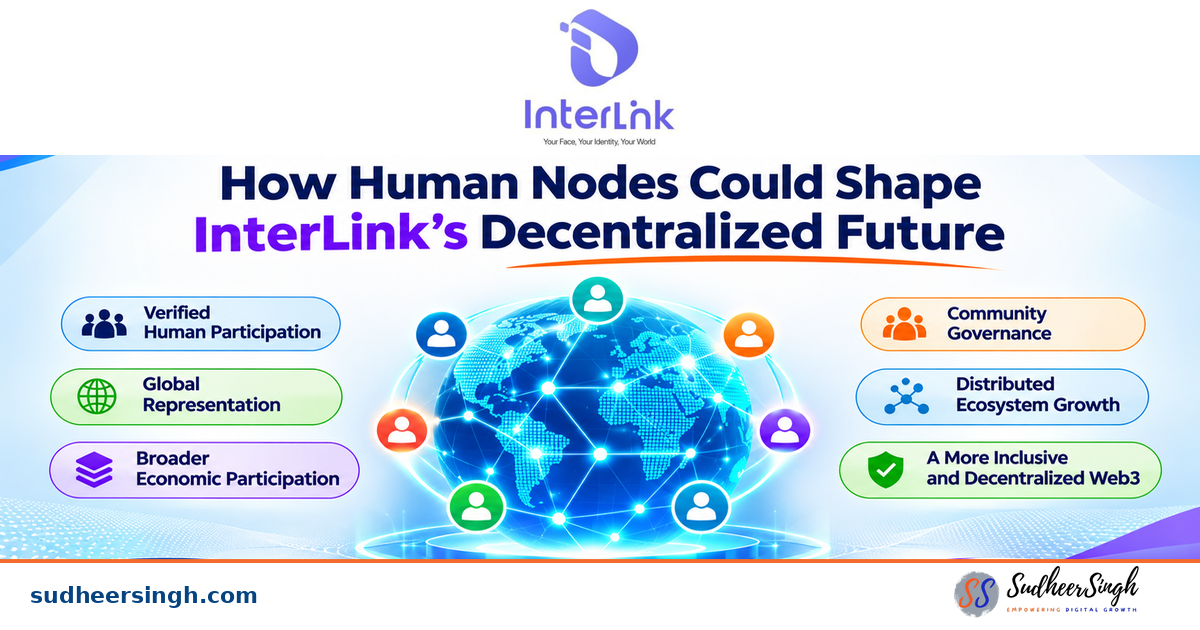
InterLink’s proposed Human Node model could contribute to decentralization in several ways.
1. Expanding Geographic Participation
A blockchain ecosystem with active participants across multiple countries and regions could benefit from a broader distribution of knowledge, perspectives, and economic activity.
Geographic diversity may also reduce dependence on a limited number of markets.
Individuals from different regions could contribute through application adoption, community education, feedback, and other eligible activities.
However, geographic diversity among users does not automatically establish geographic diversity among technical infrastructure operators.
Both aspects require separate consideration.
2. Broadening Economic Participation
Traditional financial and technological ecosystems can create barriers for individuals with limited capital or institutional resources.
InterLink’s proposed framework aims to allow verified individuals to participate alongside qualified enterprises within a shared ITLG staking ecosystem.
This could create opportunities for individual participation without requiring every participant to possess institutional-scale resources.
The accessibility of these opportunities will ultimately depend on staking requirements, asset availability, participation costs, and other implementation conditions.
3. Supporting Community-Based Governance
A globally distributed community could contribute valuable perspectives to decisions about ecosystem development.
InterLink has described a proposed one-node-one-vote governance vision within its staking framework.
Such an approach could potentially recognize eligible Human Nodes as governance participants without relying exclusively on the amount of ITLG they hold.
However, meaningful governance requires transparent voting rules, safeguards against duplicate participation, clear proposal procedures, and mechanisms for implementing decisions.
The final governance framework will determine how much influence individual participants can exercise.
4. Encouraging Diverse Ecosystem Contributions
A blockchain economy requires more than technical infrastructure.
Developers, educators, entrepreneurs, businesses, and everyday users can contribute to the adoption and usefulness of decentralized applications.
Human Nodes could represent a diverse community capable of supporting these activities.
For example, individuals may identify practical problems that developers can address through new applications. Others may help businesses understand local markets or provide feedback on existing services.
These contributions could support ecosystem development even when participants do not directly operate blockchain infrastructure.
5. Reducing Dependence on a Small Group of Participants
A network that relies heavily on a small number of organizations or economically powerful participants may face concentration risks.
Broader individual participation could help diversify community involvement and economic activity.
However, the extent to which Human Nodes reduce concentration will depend on the actual distribution of governance authority, asset ownership, and technical responsibilities.
Participation must translate into meaningful influence before it can be considered a measurable contribution to decentralization.
Millions of Human Nodes: Does Scale Guarantee Decentralization?
InterLink’s ambition to build a network supported by millions of verified Human Nodes represents a significant community-oriented objective.
Nevertheless, a large participant count alone does not guarantee decentralization.
Consider two hypothetical blockchain ecosystems.
The first has millions of registered users, but a small number of organizations control its infrastructure, governance, and protocol development.
The second has fewer users, but its infrastructure and decision-making authority are distributed across many independent participants.
The first ecosystem may have greater adoption, while the second may demonstrate stronger decentralization in certain technical or governance dimensions.
This illustrates why user numbers and decentralization must be evaluated separately.
| Measurement | What it indicates |
|---|---|
| Verified human participants | Breadth of identity-based participation |
| Active ecosystem users | Actual adoption and engagement |
| Independent infrastructure operators | Distribution of technical responsibilities |
| Geographic distribution | Diversity across regions and jurisdictions |
| Asset ownership concentration | Distribution of economic resources |
| Governance participation | Breadth of decision-making involvement |
| Protocol upgrade authority | Distribution of control over network development |
A credible assessment of InterLink’s future decentralization would require evidence across these dimensions.
The number of verified Human Nodes could become an important indicator of community participation, but it should form part of a broader evaluation.
Human Nodes and Enterprise Nodes: Balancing Community and Institutional Influence
InterLink’s proposed economic framework includes both Human Nodes and Enterprise Nodes.
Human Nodes represent eligible verified individuals, while Enterprise Nodes represent qualified businesses participating under their legal identities.
These participant categories could contribute different capabilities.
Human Nodes could support community adoption, geographic diversity, and individual participation.
Enterprise Nodes could contribute business expertise, economic resources, infrastructure, and real-world applications.
The announced vision is for both categories to participate through a shared ITLG staking framework with the same intended participation rights and benefits.
This relationship could help connect community-driven participation with institutional capabilities.
However, institutional involvement also introduces important governance considerations.
Large businesses may possess substantial financial resources, operational infrastructure, and organizational influence. A decentralized ecosystem must therefore establish appropriate safeguards to prevent excessive concentration of control.
The objective should not be to exclude institutional participation, but to create a framework in which individuals and businesses can contribute without undermining the distribution of authority.
Read InterLink’s Equal Participation Model: Individuals and Global Enterprises for a detailed explanation of this proposed relationship.
The Role of Proof of Humanity in Decentralized Governance
Proof of Humanity describes approaches intended to establish that digital participants represent genuine, distinct human beings.
In blockchain governance, this concept is particularly relevant to a challenge known as a Sybil attack.
A Sybil attack involves creating multiple identities to obtain disproportionate influence within a system.
For example, a governance mechanism that grants one vote to every wallet could be vulnerable if a single participant can create numerous eligible wallets.
Identity-based participation could help address this challenge by linking eligibility to verified participants rather than unrestricted wallet creation.
However, effective Proof of Humanity mechanisms must address several practical considerations:
- Accuracy of identity verification.
- Prevention of duplicate or fraudulent identities.
- Protection of sensitive personal information.
- Accessibility for participants in different regions.
- Transparent eligibility and dispute-resolution procedures.
- Independence and accountability of verification systems.
A system that relies on a highly centralized identity verification authority may introduce new concentration risks.
Therefore, the relationship between identity verification and decentralization requires careful architectural design.
InterLink’s human-centric approach provides an opportunity to explore this relationship as its proposed participation framework develops.
Challenges InterLink Must Address
Building a globally decentralized ecosystem around verified human participation introduces several important challenges.
Identity Privacy and Security
Verification mechanisms must protect sensitive personal information and minimize unnecessary exposure of identity data.
Participants should have clear information about how their data is collected, processed, stored, and protected.
Accessibility and Inclusion
Individuals across different regions may face varying levels of access to technology, identity documents, and financial resources.
Participation requirements should consider these differences to avoid creating unnecessary barriers.
Economic Concentration
Even when individual participants receive equal recognition, digital asset ownership may remain unevenly distributed.
Transparent economic rules are necessary to understand how asset concentration affects participation and influence.
Governance Accountability
A decentralized governance system must establish clear responsibilities, voting procedures, proposal requirements, and safeguards against manipulation.
Without effective implementation, participation rights may exist in principle without producing meaningful influence.
Technical Infrastructure Distribution
The decentralization of blockchain infrastructure requires independent operators, resilient network architecture, and appropriate distribution of operational responsibilities.
A large Human Node community cannot replace these technical requirements.
Long-Term Engagement
Sustainable participation depends on genuine utility and continued ecosystem activity.
A network must provide reasons for individuals and businesses to remain engaged beyond short-term incentives.
Addressing these challenges will be essential to translating InterLink’s proposed decentralization vision into measurable outcomes.
How Could InterLink’s Decentralization Be Evaluated in the Future?
As InterLink’s ecosystem develops, several indicators could help assess its progress.
The number of unique, verified, and active Human Nodes could provide insight into the breadth of community participation.
The geographic distribution of participants could reveal whether adoption extends across different regions.
The distribution of independent infrastructure operators could help evaluate technical decentralization.
Governance participation data could demonstrate whether eligible individuals and enterprises actively contribute to decisions.
Asset ownership and staking distribution could help identify potential economic concentration.
Transparent information about protocol upgrades and administrative authority could also provide insight into the distribution of control.
Together, these indicators would offer a more comprehensive understanding of decentralization than community size alone.
Frequently Asked Questions
What are Human Nodes in InterLink?
Human Nodes represent eligible verified individuals within InterLink’s proposed blockchain participation framework. They are designed to participate through the applicable ITLG staking mechanism after satisfying the relevant requirements.
How could Human Nodes contribute to decentralization?
Human Nodes could broaden community participation, geographic diversity, economic involvement, and eligible governance participation. Their actual contribution will depend on the final network architecture and governance rules.
Are Human Nodes blockchain validators?
Not necessarily. Human Node status describes a proposed participant category. Technical transaction validation and consensus responsibilities require separate confirmation through official network documentation.
Does having millions of Human Nodes guarantee decentralization?
No. Genuine decentralization also depends on infrastructure distribution, governance authority, economic concentration, and control over network operations.
Why is Proof of Humanity important for decentralization?
Proof of Humanity could help distinguish unique human participants from duplicate or automated identities. This may support identity-based governance and community participation, provided appropriate safeguards are implemented.
Can Enterprise Nodes support decentralization?
Qualified enterprises could contribute infrastructure, business expertise, and economic activity. Their contribution to decentralization would depend on how operational responsibilities and governance influence are distributed.
Is InterLink already one of the world’s most decentralized blockchains?
InterLink has expressed this as a long-term ambition. Establishing such a position would require measurable evidence and comparison with other blockchain networks.
Final Thoughts
InterLink’s proposed Human Node model introduces a vision of blockchain participation centered on verified individuals.
By connecting human identity with economic participation and potential governance involvement, the framework could support a more geographically diverse and inclusive digital ecosystem.
However, genuine decentralization requires more than a large community.
It depends on how effectively technical infrastructure, economic opportunities, governance authority, and operational responsibilities are distributed.
Human Nodes could become an important foundation for InterLink’s decentralized future, particularly if individual participation translates into meaningful opportunities and accountable governance.
Ultimately, the strength of InterLink’s decentralization will be determined not simply by how many people join the network, but by how independently and meaningfully those participants can contribute to its development.
Further Reading
- InterLink Human Nodes: From Verified Identity to Network Participation
- InterLink’s Equal Participation Model: Individuals and Global Enterprises
- Prove, Earn, Govern: InterLink’s Web3 Participation Model
- KYC vs. KYB in Web3: Human and Enterprise Nodes Explained
- What Is the ITLG Staking Vault? Human Nodes vs. Enterprise Nodes
For current project developments and implementation announcements, visit the official InterLink website.
Author Disclosure: Sudheer Singh Banoth is an InterLink Tier 3 Ambassador. This article provides independent educational commentary on blockchain technology and InterLink’s proposed ecosystem developments. It does not constitute financial, investment, or legal advice.
#InterLink #ITLG #ITL