Institutional participation in blockchain ecosystems is often associated with large investments, digital asset ownership, and staking commitments.
However, acquiring digital assets does not necessarily establish that a business is credible, financially responsible, or capable of contributing meaningful value to a decentralized economy.
InterLink’s proposed Enterprise Node qualification framework introduces a broader approach to institutional blockchain participation.
Rather than allowing businesses to qualify solely through their financial resources, InterLink aims to establish a framework that considers legal identity, business reputation, financial capabilities, transparency, and long-term ecosystem contributions.
This approach could help connect verified individuals and accountable enterprises within a shared blockchain economy.
But what would it actually take for a business to become an Enterprise Node?
What Is an Enterprise Node in InterLink?
An Enterprise Node represents a qualified business or institution participating within InterLink’s proposed blockchain economy under its verified legal identity.
Enterprise Nodes are designed to participate alongside Human Nodes through a shared ITLG Staking Vault.
While Human Nodes represent verified individuals, Enterprise Nodes could contribute institutional expertise, financial resources, commercial applications, and business infrastructure.
The proposed framework aims to establish greater accountability by connecting institutional participation with identifiable legal entities and transparent economic commitments.
However, becoming an Enterprise Node is expected to involve more than purchasing and staking ITLG.
Businesses would need to satisfy applicable verification and qualification requirements before participating.
For an overview of how both participant categories could operate together, read InterLink’s Equal Participation Model: Individuals and Global Enterprises.
Why Enterprise Qualification Matters in Blockchain
Blockchain technology allows organizations to interact with digital assets, decentralized applications, and financial infrastructure.
Nevertheless, a blockchain wallet alone does not necessarily reveal the legal identity, ownership structure, financial condition, or operational history of the business controlling it.
This creates challenges when institutional participation involves governance, long-term economic commitments, or services provided to other ecosystem participants.
An enterprise qualification framework could help address these challenges by establishing appropriate standards for institutional participation.
Potential objectives include:
- Identifying the legal entities behind institutional wallets.
- Establishing greater transparency regarding business ownership.
- Evaluating organizational credibility and financial capabilities.
- Encouraging accountable long-term participation.
- Supporting meaningful contributions to ecosystem development.
These measures cannot eliminate every business or financial risk. However, they could provide a stronger foundation for evaluating institutional participants.
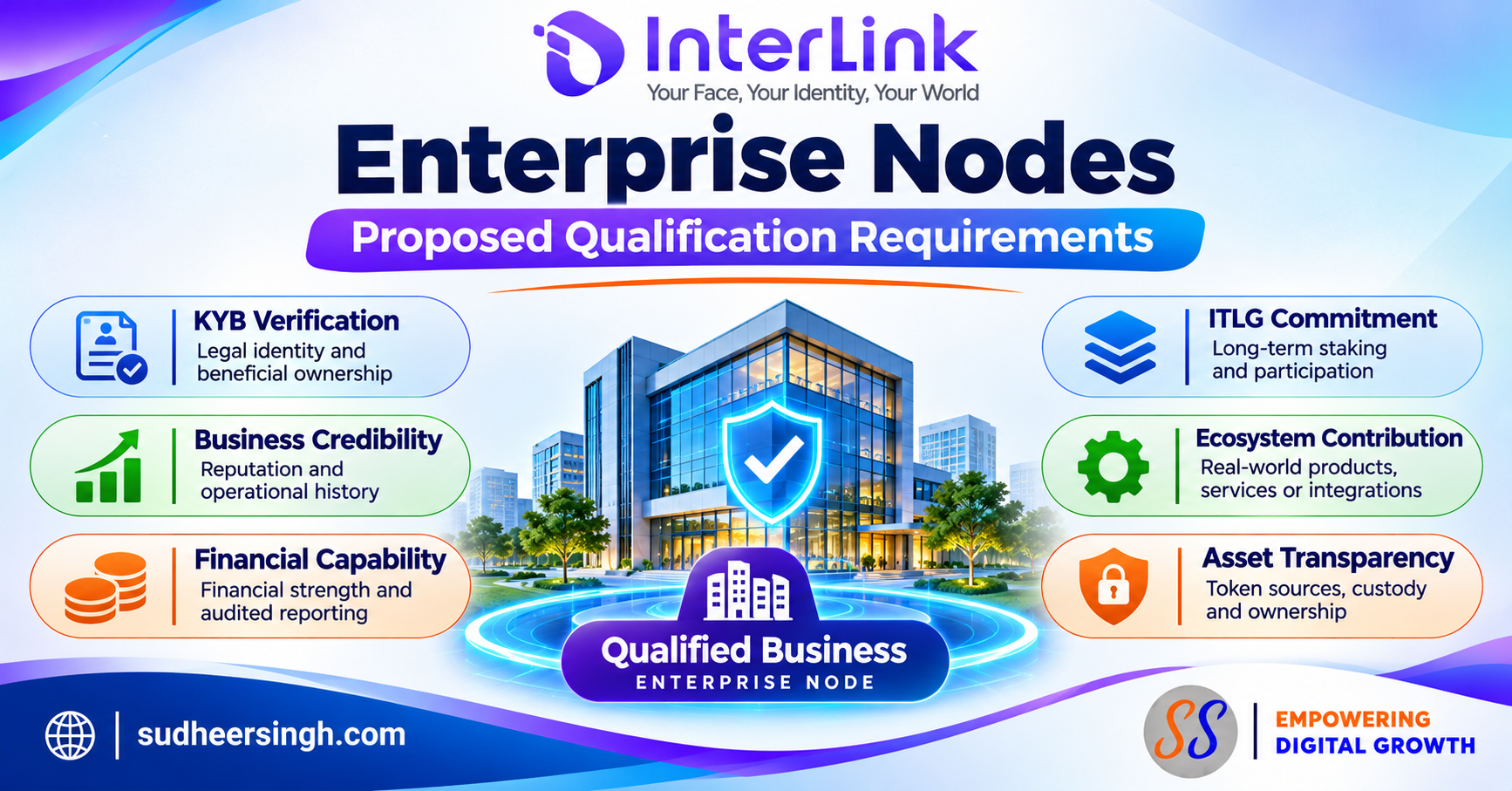
Six Proposed Enterprise Node Qualification Requirements
InterLink’s announced vision identifies several important considerations for businesses seeking to participate as Enterprise Nodes.
These considerations describe the proposed qualification framework rather than a finalized application procedure.
1. KYB Verification of Legal Entities and Beneficial Owners
Know Your Business, commonly known as KYB, refers to processes used to establish and verify the identity of a business.
Unlike Know Your Customer (KYC), which focuses on individuals, KYB considers the legal and organizational structure of a business.
A typical KYB process may examine:
- Business registration information.
- Legal company name and jurisdiction.
- Directors and authorized representatives.
- Corporate ownership structure.
- Ultimate beneficial owners.
- Business activities and applicable regulatory requirements.
These examples illustrate common KYB considerations. InterLink’s final documentation will determine the exact information and documents required.
Verifying beneficial ownership is particularly important because the registered name of a company does not always reveal the individuals who ultimately own or control it.
By establishing a clearer connection between businesses and their legal identities, KYB could support greater accountability within the proposed Enterprise Node framework.
For a detailed comparison, read KYC vs. KYB in Web3: Human and Enterprise Nodes Explained.
2. Business Reputation, Operational History and Financial Capabilities
Legal registration establishes that a business exists. However, it does not necessarily establish that the business is financially credible or operationally reliable.
InterLink’s proposed Enterprise Node framework also considers business reputation, operational history, and financial capabilities.
These considerations could help evaluate whether an organization has the resources and operational capacity to support long-term participation.
For example, a business with an established operational history may be able to demonstrate its commercial activities, organizational structure, and ability to maintain financial commitments.
Financial capability may also become relevant when an enterprise intends to hold digital assets, develop blockchain applications, or contribute infrastructure.
However, specific minimum revenue requirements, capital thresholds, and operational history requirements have not been established in the announced framework discussed here.
3. Priority for Publicly Listed or Independently Audited Businesses
InterLink’s institutional participation vision identifies publicly listed companies and businesses with independently audited financial statements as potential priority participants.
Publicly listed companies generally operate under applicable financial disclosure and reporting requirements.
Similarly, independently audited financial statements can provide additional information about a business’s financial position and reporting practices.
These characteristics could help support institutional transparency.
However, publicly listed status does not automatically guarantee financial stability, responsible governance, or successful blockchain participation.
An independent audit also does not eliminate every operational or financial risk.
The proposed preference should therefore be understood as one potential component of a broader qualification framework.
It does not establish that private companies are automatically excluded.
Nor does it confirm that any particular Nasdaq-listed or New York Stock Exchange-listed corporation has already qualified as an InterLink Enterprise Node.
4. Long-Term ITLG Staking Commitments
Enterprise Nodes are designed to participate through InterLink’s proposed ITLG Staking Vault.
The announced institutional framework emphasizes long-term staking commitments supported by publicly verifiable on-chain records.
This approach could help demonstrate that institutional participation involves an identifiable economic commitment rather than merely a promotional association with the network.
Blockchain records may allow observers to examine certain staking activities, depending on the final protocol design and available information.
However, on-chain records alone do not necessarily establish the legal ownership of an asset or the identity of every party controlling it.
Appropriate verification and custody arrangements remain important.
The final Enterprise Node staking requirements will need to clarify matters such as:
- Minimum eligible staking amounts.
- Applicable commitment periods.
- Withdrawal and unstaking conditions.
- Reward calculation mechanisms.
- Wallet eligibility requirements.
- Consequences of failing to maintain participation requirements.
These details should not be assumed before the relevant rules are confirmed.
For more information about the shared staking framework, explore What Is the ITLG Staking Vault? Human Nodes vs. Enterprise Nodes.
5. Ability to Contribute to Ecosystem Development
Enterprise participation could create value beyond digital asset ownership.
InterLink’s proposed qualification framework considers an enterprise’s ability to contribute to ecosystem development, governance, or network operations.
Different businesses may bring different capabilities.
A technology company could develop software integrations or decentralized applications.
A financial services business could explore blockchain-based payment solutions, subject to applicable regulations.
An infrastructure provider could contribute technical resources where supported by the network architecture.
Other businesses could introduce commercial services, industry expertise, or practical applications that increase ecosystem utility.
These examples illustrate potential contributions rather than confirmed partnerships or mandatory activities.
The broader objective is to encourage institutional participation that creates practical value for the ecosystem.
6. Transparency in Token Sources, Custody and Ownership
Digital asset ownership introduces important questions about financial responsibility and organizational accountability.
InterLink’s proposed Enterprise Node framework emphasizes transparency regarding:
- Sources of ITLG used for institutional participation.
- Digital asset custody arrangements.
- Ownership rights.
- Organizational responsibilities.
- Control and authorization of relevant assets.
For example, a business may hold digital assets directly or use an external custody provider.
Its internal policies may determine who can authorize transactions, access wallets, or approve staking commitments.
These arrangements can affect operational security and accountability.
Transparent ownership and custody practices could help establish a clearer understanding of institutional participation.
However, the exact disclosure requirements and acceptable custody arrangements remain subject to final implementation.
Enterprise Node Qualification Requirements at a Glance
| Qualification area | Proposed consideration | Intended purpose |
|---|---|---|
| Legal identity | KYB and beneficial ownership verification | Establish accountable business identities |
| Business credibility | Reputation and operational history | Evaluate organizational reliability |
| Financial capabilities | Financial resources and audited reporting | Support credible economic participation |
| Institutional commitment | Long-term ITLG staking | Encourage sustained participation |
| Ecosystem contribution | Development, governance or operations | Create practical ecosystem value |
| Asset transparency | Token sources, custody and ownership | Strengthen financial accountability |
These considerations demonstrate that the proposed Enterprise Node framework extends beyond a simple staking mechanism.
It aims to connect institutional economic participation with broader standards of credibility and responsibility.
How Could a Business Prepare to Become an Enterprise Node?
Although the final application procedure requires official confirmation, interested businesses could consider several preparatory steps.
Step 1: Establish Corporate Documentation
Businesses could ensure that their legal registration, ownership information, and authorized representatives are properly documented.
Step 2: Review Financial and Operational Records
Organizations could prepare relevant financial statements, operational records, and other information demonstrating their business activities.
Step 3: Establish Digital Asset Policies
Businesses considering institutional staking could evaluate their internal policies for digital asset ownership, custody, transaction authorization, and financial risk management.
Step 4: Evaluate Long-Term Participation
An organization could assess whether a potential ITLG staking commitment aligns with its financial strategy, operational objectives, and regulatory obligations.
Step 5: Identify Potential Ecosystem Contributions
Businesses could explore how their products, services, technical capabilities, or industry expertise might contribute to the InterLink ecosystem.
Step 6: Monitor Official Qualification Announcements
Before making financial commitments or submitting sensitive business information, organizations should consult verified InterLink channels for finalized eligibility requirements and application procedures.
These steps represent general preparation guidance. They are not an official Enterprise Node registration process.
Could Small and Medium-Sized Businesses Qualify?
InterLink’s proposed framework identifies publicly listed companies and independently audited businesses as potential priority participants.
However, this preference does not necessarily mean that only multinational corporations can qualify.
Small and medium-sized businesses may possess valuable technical capabilities, established customer relationships, specialized industry expertise, and practical applications for blockchain technology.
For example, a software development company could contribute integrations that improve access to decentralized applications.
A regional business could introduce practical use cases relevant to its local market.
A specialized technology provider could contribute services that support ecosystem development.
Whether such organizations would qualify depends on the final Enterprise Node admission criteria.
It would therefore be premature to assume that smaller businesses are either automatically eligible or automatically excluded.
Enterprise Nodes and the Proposed InterLink Business Token Exchange
InterLink’s broader institutional vision also includes the proposed InterLink Business Token Exchange, commonly referred to as IBTE.
Under the announced concept, businesses seeking to list on the platform would first need to become publicly verified Enterprise Nodes.
Community governance is also expected to contribute to the proposed listing process.
This could connect institutional verification with broader questions of asset eligibility, business accountability, and community participation.
However, Enterprise Node qualification should not be interpreted as automatic authorization to issue or list financial assets.
Asset tokenization and exchange operations may involve additional legal, regulatory, technical, and financial requirements.
The final IBTE framework will need to establish how these requirements are addressed.
Why Enterprise Qualification Does Not Contradict Equal Participation
Human Nodes and Enterprise Nodes have different legal identities, financial capabilities, and organizational responsibilities.
Human Nodes are expected to satisfy individual verification requirements, while Enterprise Nodes would undergo additional business qualification processes.
Nevertheless, InterLink’s stated vision is for both participant categories to enjoy the same intended participation rights and benefits within a shared economic framework.
Equal participation does not require identical verification procedures.
A business may have multiple owners, authorized representatives, corporate obligations, and complex financial arrangements.
Additional qualification requirements could therefore support institutional accountability without necessarily contradicting the principle of equal participation.
The final governance and economic rules will determine how this relationship operates in practice.
The Importance of Long-Term Institutional Accountability
Attracting businesses to a blockchain ecosystem is only one part of institutional adoption.
Maintaining credible, transparent, and productive participation over time is equally important.
An effective institutional framework may need mechanisms for addressing changes in business ownership, financial condition, operational capabilities, or compliance status.
It may also require procedures for resolving disputes and responding to organizations that no longer satisfy applicable participation requirements.
These are important design considerations rather than confirmed InterLink policies.
The effectiveness of the Enterprise Node model will depend not only on how businesses initially qualify but also on how institutional accountability is maintained over time.
Frequently Asked Questions
What is an InterLink Enterprise Node?
An Enterprise Node represents a qualified business or institution participating under its verified legal identity within InterLink’s proposed blockchain economy.
Is KYB verification enough to become an Enterprise Node?
Not necessarily. The proposed framework also considers business reputation, financial capabilities, staking commitments, transparency, and potential ecosystem contributions.
How much ITLG does a business need to become an Enterprise Node?
The announcement discussed here does not establish a specific minimum staking amount. Businesses should consult finalized official requirements before making financial commitments.
Can private companies become Enterprise Nodes?
Publicly listed and independently audited businesses are identified as potential priority participants. The final eligibility rules will determine whether and under what conditions private companies can qualify.
Do Enterprise Nodes receive higher staking rewards than Human Nodes?
InterLink’s proposed shared staking framework does not describe a separate institutional reward rate simply because a participant is a business. Actual rewards would depend on applicable staking conditions and final economic rules.
Are Enterprise Nodes automatically eligible to list assets on IBTE?
No automatic listing entitlement has been established. The proposed IBTE model identifies publicly verified Enterprise Node status as a prerequisite, with community governance contributing to the listing process.
Can businesses apply to become Enterprise Nodes now?
The proposed qualification framework does not establish a confirmed application process or operational admission status. Interested businesses should consult current official InterLink announcements.
Final Thoughts
InterLink’s proposed Enterprise Node qualification framework presents a broader vision of institutional blockchain participation.
Rather than defining enterprise involvement solely through digital asset ownership, the model emphasizes legal identity, financial credibility, long-term commitments, transparency, and meaningful ecosystem contributions.
This approach could help establish a more accountable relationship between businesses and the blockchain communities they serve.
However, the effectiveness of the framework will depend on transparent qualification standards, credible verification, sustainable economic mechanisms, and consistent institutional accountability.
The long-term value of Enterprise Nodes will ultimately depend not simply on how much ITLG businesses hold, but on what those businesses contribute to the ecosystem.
Further Reading
- InterLink’s Equal Participation Model: Individuals and Global Enterprises
- How Human Nodes Could Shape InterLink’s Decentralized Future
- KYC vs. KYB in Web3: Human and Enterprise Nodes Explained
- What Is the ITLG Staking Vault? Human Nodes vs. Enterprise Nodes
- Prove, Earn, Govern: InterLink’s Web3 Participation Model
For current project developments and implementation announcements, visit the official InterLink website.
Author Disclosure: Sudheer Singh Banoth is an InterLink Ambassador. This article provides independent educational commentary on blockchain technology and InterLink’s proposed ecosystem developments. It does not constitute financial, investment, or legal advice.
#InterLink #ITLG #ITL